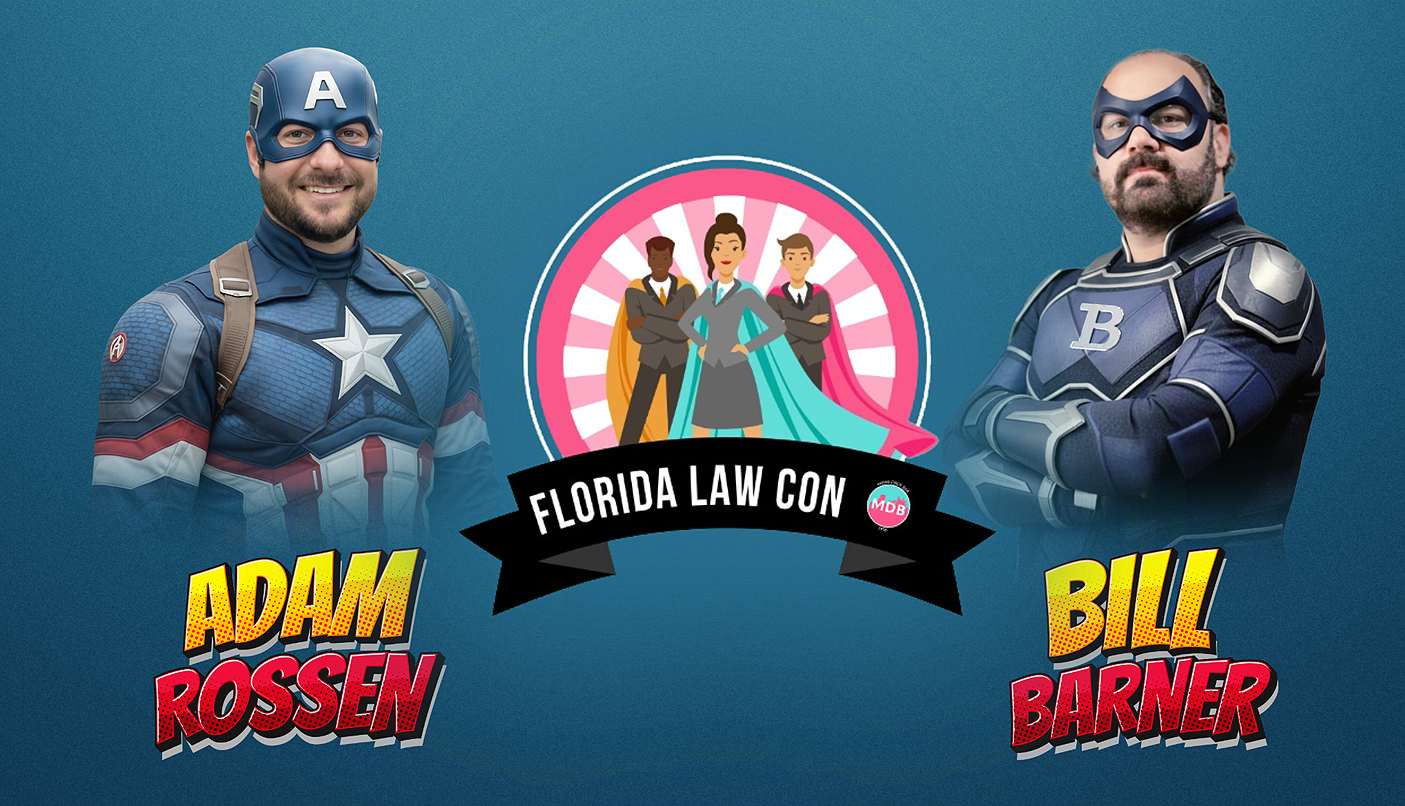
Adam D. Rossen, founder and CEO of Rossen Law Firm, joined immigration attorney Bill Barner of Barner Legal to present “Crimmigration: What Every Florida Criminal Defense Attorney Needs to Know” at Florida Law Con 2026, a continuing legal education conference presented in partnership with the Miami-Dade Bar. The session streamed as part of the conference’s live program on April 10, 2026, with the recording made available on demand to registered attendees.
Rossen, a former prosecutor, and Barner, an immigration attorney who has represented clients in federal criminal, state criminal, and immigration courtrooms across Florida, built the session around a problem they had each started seeing more often from opposite sides of the same cases: criminal defense attorneys and immigration attorneys who never talk to each other, with devastating consequences for clients caught in between.
Why “Crimmigration” Is a Distinct Practice Area
For a citizen, a DUI, a domestic battery charge, or a petty theft charge carries the consequences everyone expects — fines, probation, sometimes jail. For a client without U.S. citizenship, the same charge can carry consequences that reach far beyond the criminal case: mandatory immigration detention, deportation proceedings, a permanent bar to re-entry, and family separation.
The legal landscape around this has shifted meaningfully in recent years. The Laken Riley Act, signed into federal law in January 2025, expanded mandatory immigration detention to cover certain arrests — not just convictions — for offenses including burglary, theft, larceny, shoplifting, and crimes causing death or serious bodily injury. That change reaches undocumented individuals, DACA recipients, TPS holders, asylum seekers, and lawful permanent residents alike, which means immigration exposure is no longer a narrow issue affecting only a small subset of clients.
The Moment Before Bond Is Often the Moment That Matters Most
One of the session’s central warnings: when a client with immigration exposure is arrested, the instinct to get them out of jail quickly can backfire. An ICE detainer allows immigration authorities to request that a client be held for up to 48 hours after their criminal case would otherwise release them — and posting bond on the criminal side does not release that client. It can deliver them directly into ICE custody, where mandatory detention may apply and no bond hearing is available at all.
Before advising a client on bond, Rossen and Barner urged attorneys to ask three questions: What is the client’s immigration status? Is there an active ICE detainer? Are they subject to mandatory detention under INA § 236(c)?
Not Every Client Gets a Bond Hearing
Under INA § 236(c), the federal government must detain without bond any noncitizen who is deportable or inadmissible based on an aggravated felony, a crime involving moral turpitude (absent a narrow petty-offense exception), a drug offense, a firearms offense, or two or more criminal convictions with combined sentences of five years or more. The Laken Riley Act extended mandatory detention to noncitizens merely charged — not yet convicted — of certain offenses.
Even lawful permanent residents, including those who have lived in the U.S. for decades, are not shielded from these consequences. A single qualifying conviction can trigger deportation, and an aggravated felony conviction operates as a permanent bar to re-entry — no asylum, no cancellation of removal, no discretion available.
The Categorical Approach: Why the Same Florida Charge Can Have Different Immigration Outcomes
A recurring theme of the session was that immigration courts do not look at what a client actually did — they look at what the underlying statute requires. This is known as the categorical approach, and it is among the most technical, high-stakes analyses in crimmigration law. A court examines the elements of the Florida statute rather than the facts of the case; if the statute’s minimum conduct matches a federal removal ground, the conviction is treated as deportable regardless of what actually happened. When a statute is “divisible” — meaning different subsections define different crimes — courts may look further, to charging documents, plea transcripts, and plea agreements, under what is called the modified categorical approach.
Rossen and Barner illustrated this with two Florida examples. Florida’s aggravated assault statute, § 784.021, can be charged based on either a “deadly weapon” or a “firearm” — and because using a firearm may qualify as an aggravated felony under federal law while using another kind of weapon may not, two versions of the same Florida charge can produce two very different immigration outcomes. Similarly, Florida’s felony battery statute requires “great bodily harm,” while simple battery under § 784.03 requires only intentional touching — meaning a statute broader than the federal definition of a “crime of violence” may not trigger removal at all, even where the underlying conduct was serious.
Why the Call Usually Comes to the Criminal Defense Attorney First
Rossen and Barner emphasized a practical reality: when someone with immigration exposure is arrested in Florida, they typically call a criminal defense attorney first — not an immigration attorney. That makes the criminal defense attorney’s intake process the first, and sometimes only, opportunity to catch an immigration issue before it becomes unrecoverable.
They recommended that intake teams treat a short set of questions as standard practice on any call involving a potential noncitizen client: Is the client a U.S. citizen, and if not, what is their current immigration status? Do they hold a green card, visa, DACA, TPS, or a pending application? Do they have any other arrests or convictions, in the U.S. or elsewhere? Have they received any notices from immigration authorities, or is there an ICE hold? How long have they been in the United States? Asking these questions is not immigration advice — it is the information gathering that determines how much time a legal team has to protect the client, including through the pre-file window, often the 21 to 40 days before the State Attorney formally files charges, during which the most protective outcomes are frequently negotiated.
Where the Gaps Actually Happen
The session walked through several patterns Rossen and Barner have seen firsthand: a criminal defense attorney negotiating a plea to “theft” without recognizing that a one-year sentencing guideline can make it an aggravated felony for immigration purposes; an immigration attorney advising a client to cooperate with prosecutors without understanding how that statement affects the pending criminal case; a client bonded out immediately after arrest without anyone checking for an ICE hold; a guilty plea to a Florida statute that, on its face, sounds minor but can be categorized as a removable offense under federal law.
Their conclusion was direct: a criminal defense attorney is not an immigration attorney, and an immigration attorney is not a criminal defense attorney. When either side handles a case in isolation, or when neither side knows what the other is doing, clients fall through the gap between the two practice areas. Coordination between the two — early, and before a plea is finalized — is what prevents it.
A Practical Protocol for Both Sides
Rossen and Barner closed the session with parallel checklists for each side of the practice:
For criminal defense attorneys: Ask immigration status on every intake call. Identify ICE holds before advising on bond. Contact immigration counsel before pre-file negotiations on any noncitizen client. Never assume a withhold of adjudication or a diversion program is automatically “safe” for immigration purposes. Know the pre-file window — it is often the single most powerful tool available.
For immigration attorneys: Know the client’s full criminal history before any hearing. Understand the categorical approach exposure on pending Florida charges. Review the actual charging documents and plea transcript, not just the name of the offense. Check for the petty offense exception before assuming mandatory detention applies. Get involved in the criminal case early — the pre-plea stage is where an immigration attorney can do the most good.
As Rossen and Barner put it to the room: one phone call between the right two attorneys, made early enough, can change everything for a client.
About Adam Rossen
Adam D. Rossen is the founder and CEO of Rossen Law Firm, a South Florida criminal defense firm dedicated to helping good people when bad things happen. A former prosecutor practicing since 2006, he founded the firm in 2008 and has grown it into a multi-attorney practice serving Broward, Miami-Dade, and Palm Beach counties. Rossen regularly teaches other attorneys through CLE programs across Florida, with a particular focus on the practical realities defense attorneys face today — including how criminal and immigration consequences increasingly intersect. Read more about Adam Rossen.
About Bill Barner
Bill Barner, Esq. is the Managing Partner of Barner Legal, an immigration law firm. He has represented clients in federal criminal, state criminal, and immigration courtrooms throughout Florida and the U.S., and has counseled foreign nationals from more than 30 countries on the intersection of criminal and immigration issues. Barner has advised state legislators and criminal defense attorneys on immigration matters, has been published in his field, and teaches Immigration Law as an adjunct professor at Nova Southeastern University. Learn more at barnerlegal.com.
About Rossen Law Firm
Rossen Law Firm is a South Florida criminal defense law firm representing clients in DUI, federal crimes, drug crimes, domestic violence, sex crimes, theft crimes, probation violations, and other serious criminal matters throughout Broward, Miami-Dade, and Palm Beach counties. The firm is committed to defending good people when bad things happen and to helping clients protect their futures — including, where a case calls for it, coordinating closely with immigration counsel to protect a client’s full range of interests. Contact our firm to learn more.
A recording of this session was made available on demand through Florida Law Con following the live program.