Adam D. Rossen, founder and CEO of Rossen Law Firm, presented "The Tech-Enabled Defender: A Criminal Defense Lawyer's Blueprint for the New Reality of AI" at the Florida Association of Criminal Defense Lawyers (FACDL) 39th Annual Meeting, held June 4–7, 2026, at the Margaritaville Hollywood Beach Resort in Hollywood, Florida.
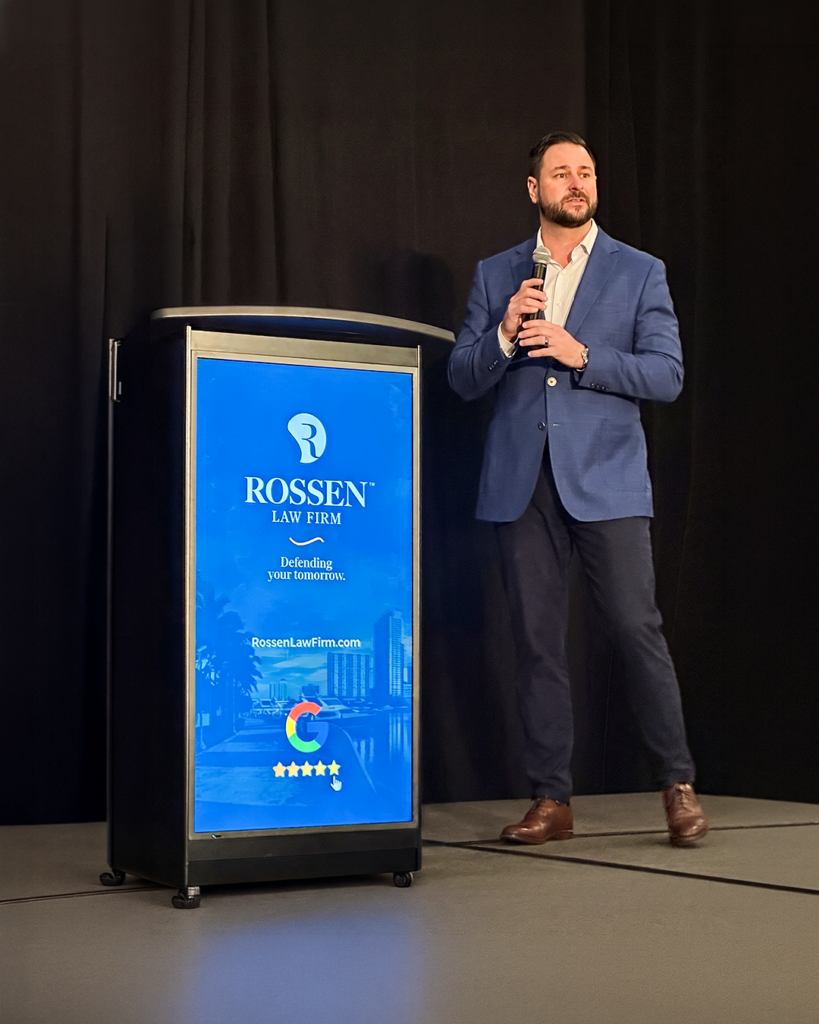
A former prosecutor who has rebuilt his own firm around artificial intelligence, Rossen used his morning session to give Florida's defense bar something more useful than predictions: a working blueprint for putting AI to use in a criminal practice (ethically). The timing was deliberate. Just days later, on June 15, 2026, Florida's new statewide rule on AI in court filings took effect, making the question Rossen addressed, how do you use these tools without getting burned? an immediate one for every lawyer in the room.
"AI doesn't replace a defense lawyer's judgment, but it protects the time and attention that judgment requires," said Rossen. "When a tool clears a 2,000-page discovery dump in an afternoon, you get those hours back for the work that actually wins cases, and you walk into court more prepared than the prosecutor."
The New Reality Rossen Addressed
Rossen opened on a sharp point: in the AI era, the old assumptions about "practical obscurity" no longer hold. Tools that can synthesize public data at scale have made redaction far less reliable than lawyers assume. His message to the room was that AI is no longer optional to understand, even for attorneys who never intend to use it, because opposing counsel, clients, and courts already are.
From there, the session stayed firmly practical. Rather than debate the philosophy of AI, Rossen walked through the specific toolkit Rossen Law Firm uses every day, what each tool costs, and how any Florida criminal defense lawyer can implement it without a technical background.
Five AI Tools for the Tech-Enabled Defender
Rossen's session broke the working toolkit into five categories. The summaries below reflect how his firm uses each one.
1. AI document analysis. Source-grounded research tools such as Google's NotebookLM let an attorney upload an entire case file and ask questions across hundreds of pages, with answers drawn only from the uploaded materials. This reduces the risk of fabricated sources. Rossen noted the practical limits, too: tools like this don't process body-camera video or visually analyze crime-scene and injury photos.
2. Purpose-built AI for criminal defense. Platforms built specifically for defense work (Rossen highlighted Trialkit) can process case documents, body-camera footage, and crime-scene photos together and output memos formatted for defense case preparation, filling the gaps general tools leave.
3. AI for depositions. Testimony-management platforms such as Prevail provide live transcription with speaker tagging and collaborative notes during a deposition, plus AI-generated summaries immediately afterward.
4. AI-assisted legal research. Research tools that connect to real, citable case law (Rossen pointed to Midpage and Vincent AI via Fastcase) let attorneys reason across authorities and draft memos grounded in existing cases. As Florida's new filing rule makes clear, that grounding is no longer a nicety.
5. AI voice capture. Hardware tools such as Plaud convert recorded audio into structured summaries, mind maps, and action items, capturing the thinking that would otherwise be lost between the courthouse and the office.
Using AI Ethically
The heart of Rossen's session was that none of these tools change a lawyer's existing duties; they just apply them to new technology. He walked the room through the governing framework:
- ABA Formal Opinion 512 (July 2024) applies the duties lawyers already know: competence, confidentiality, communication, reasonable fees, candor, and supervision directly to generative AI. The throughline: a hallucinated citation is the lawyer's problem, not the AI's.
- Florida Ethics Opinion 24-1 (January 2024), followed by AI-specific comments added to Bar rules in October 2024, made the state's expectations explicit: get informed consent before client confidences go into a third-party self-learning tool, vet vendors on data retention and sharing, and never delegate lawyer judgment.
- Florida Rule of General Practice and Judicial Administration 2.515(d)(2), adopted in In re: Amendments to Rule 2.515, Case No. SC2026-0673 (decided May 28, 2026) and effective June 15, 2026, now provides that by signing and filing a document, the signer represents that the legal authorities cited exist and are accurately cited. There is no separate AI disclosure requirement; signing is the certification, and courts may impose sanctions, up to dismissal, for filings inconsistent with it. (See The Florida Bar's coverage.)
Rossen's practical rule of thumb for the room: treat AI like a first-year associate. Useful for a draft, never trusted for final work product, and never a substitute for the lawyer who signs. Verify every citation before you sign, because you own every authority in every filing that carries your name.
Helping Other Firms Make the Shift
Rossen's appearance at FACDL reflects a larger commitment that runs beyond his own practice. He teaches Criminal Law and Criminal Procedure at American Heritage School, has taught more than ten CLE programs, and has built Rossen Law Firm into a model of what an AI-enabled criminal defense practice can look supported by a written, firm-wide AI use policy that names approved tools, sets verification rules, and trains every team member, exactly the kind of supervision structure the ethics rules now call for.
He is also a co-founder of Torq Legal Labs, a venture building AI tools designed to give every person at a law firm an AI counterpart drawn from the firm's own knowledge. The throughline across all of it is the same: technology should free a legal team to do more of the work only humans can do, and the firms that learn to use it well will serve clients better than those that don't.